Gum Health
The 4 stages of gum disease — and what usually separates them
When dental professionals talk about "gum disease," they are usually describing a slow process with four commonly recognized stages. Each one has its own signs, and the move between them is usually easier to catch than it looks.
The phrase "gum disease" covers a range of changes to the tissue and bone that hold teeth in place. Most cases do not jump from healthy to serious overnight. They tend to move through stages that can be measured, watched, and — when caught early — slowed down. This briefing walks through the four stages dental professionals commonly use to describe that progression, in plain English.
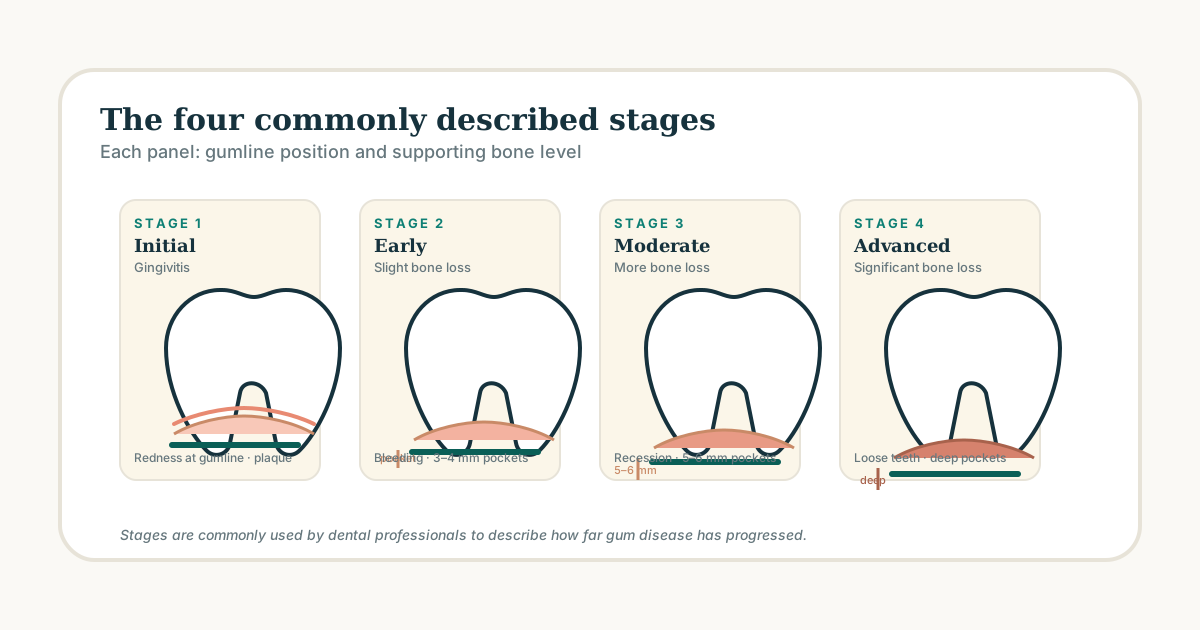
Stage 1 — Initial (gingivitis)
The earliest stage is usually called gingivitis. The supporting bone is still where it should be. What changes is the soft tissue at the gumline: a thin red rim, tenderness when brushing, occasional bleeding on floss, and breath that does not fully clear with brushing. Plaque sits along the gumline, and the tissue reacts to it.
This stage is the easiest to miss because it rarely hurts. People often assume bleeding during brushing means they brushed too hard, when the more common explanation is that the tissue was already irritated. Daily cleaning at the gumline and saliva doing its job usually bring the tissue back to a calmer look within a couple of weeks.
Stage 2 — Early periodontitis
If irritation sticks around, the body starts to lose a little of the bone that anchors the tooth. The pockets between gum and tooth, normally 1–3 millimeters, deepen to about 4 millimeters. Bleeding on brushing becomes routine rather than occasional. The gumline may begin to look slightly puffy or rolled, and a dental professional can measure the change with a small probe.
At this stage, the changes are still mostly reversible in the sense that the bone that has been lost has not disappeared. A careful cleaning below the gumline, paired with steady home care, is the typical response. The shift that matters is the pocket depth — it is the sign that irritation has reached the structures that hold the tooth in place.
Stage 3 — Moderate periodontitis
By the moderate stage, bone loss becomes a real measurement. Pockets often reach 5–6 millimeters. Gums may visibly recede, exposing more of the tooth or even a little of the root surface. Teeth can start to feel slightly different when biting, and bad taste or odor becomes harder to manage at home. Inflammation is no longer a thin red rim — it is a more obvious redness, swelling, or tenderness in places.
What separates moderate from early is the speed of the change. Once pockets are deep enough to harbor bacteria that brushing cannot reach, the loss of bone tends to accelerate if nothing changes. Dental care at this stage usually goes beyond routine cleaning and may involve deeper measurements, X-rays, and a more structured plan.
Stage 4 — Advanced periodontitis
The advanced stage is marked by significant bone loss, often visible on imaging, and by signs a person can feel: loose teeth, teeth that have drifted or shifted, gaps that did not used to be there, and discomfort when chewing. Pockets may exceed 7 millimeters. The gumline has usually receded enough that teeth look longer, and the tissue can feel tender, swollen, or bleed without obvious cause.
This is the stage most people picture when they hear the phrase "gum disease." It is also the stage that takes the longest to reach. By the time teeth feel loose, the changes have usually been building for years, often quietly. Care at this point is more involved and is something a dental professional needs to direct.
What usually separates one stage from the next
The clearest marker across all four stages is pocket depth — the small space between the gum and the tooth, measured in millimeters by a dental probe:
- Healthy or stage 1: pockets roughly 1–3 mm; tissue color returns to a calmer look within days of steady cleaning.
- Stage 2 (early): pockets around 4 mm; bleeding is common; bone loss shows up on imaging.
- Stage 3 (moderate): pockets around 5–6 mm; recession becomes visible; teeth can start to drift.
- Stage 4 (advanced): pockets above 7 mm; teeth feel loose; significant bone loss is visible on imaging.
None of those numbers is a diagnosis on its own. A dental professional looks at them alongside bleeding, recession, mobility, and how the bone looks on imaging. But pocket depth is the single measurement that tends to track the progression most consistently.
When to bring it up at the dentist
A short conversation at the next cleaning is enough if the only thing noticed is occasional bleeding on floss or a faint redness that does not settle. A sooner visit makes sense if bleeding is happening without obvious cause, the gumline has visibly moved, breath keeps coming back despite good cleaning, a tooth feels different, or any single area is painful, swollen, or draining.
The point of knowing the stages is not to self-diagnose. It is to know which signs are routine and which ones deserve a prompt look — and to understand why dental professionals measure what they measure.